Two DDTC Professionals Cover Tax Disputes in International Publication
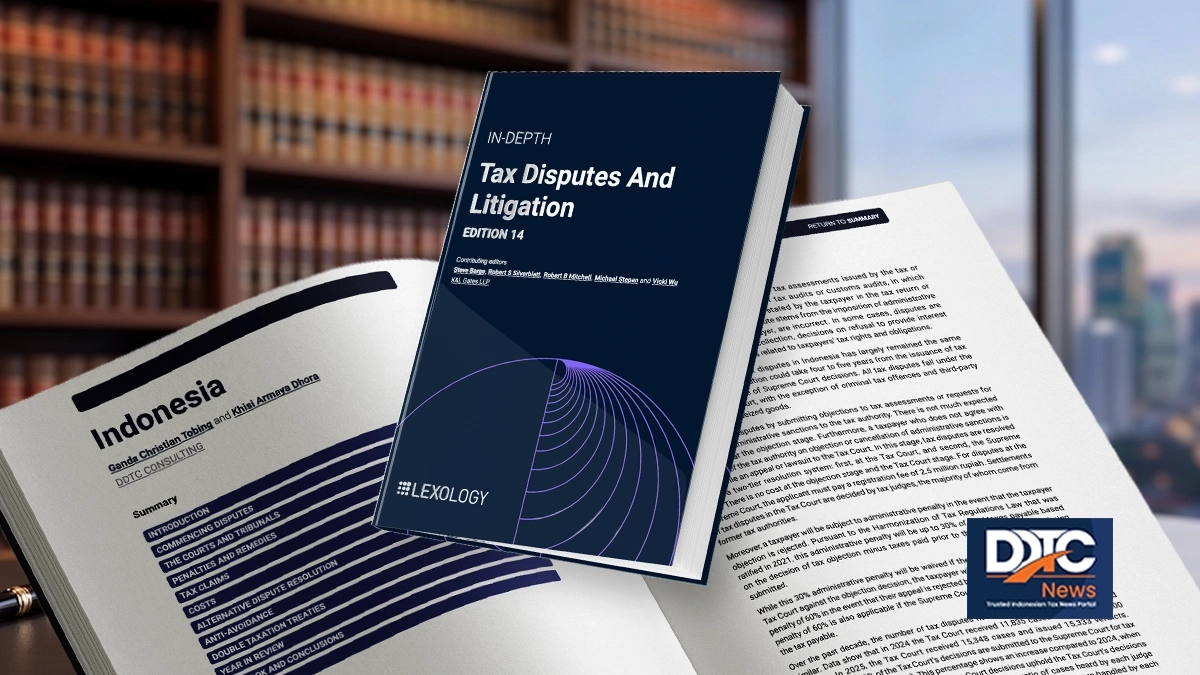
JAKARTA, DDTCNews - Tax law enforcement in Indonesia is beginning to consolidate a number of supporting elements, including the utilisation of data, exchange of information, digital forensics as well as reforms to the audit process and dispute resolution. At the same time, the protection of taxpayer rights and legal certainty remains the primary challenge in resolving tax disputes.
This topic is examined in depth by 2 DDTC professionals, namely Partner of DDTC Consulting, Ganda Christian Tobing, and Senior Manager of DDTC Consulting, Khisi Armaya Dhora, in the publication Lexology In-Depth: Tax Dispute and Litigation Edition 14. Published in June 2026, this publication was compiled by Law Business Research, based in London, UK.
Ganda and Khisi join experts from 14 other countries to outline the conditions and challenges of tax law enforcement worldwide. They are joined by contributors from 14 other countries, namely Cyprus, Finland, Greece, Italy, Japan, Luxembourg, Malaysia, the Netherlands, New Zealand, Nigeria, Slovenia, South Korea, Trinidad and Tobago and the United States.
This is not the first occasion on which either DDTC professional has contributed to an international publication on tax disputes. Ganda and Khisi have also appeared in the same international publication over the past 2 years. To date, more than 40 contributions by DDTC professionals have been published in international publications. The full collection may be viewed here.
In this report, Ganda and Khisi highlight the qualification of evidence pursuant to the Supreme Court Circular Letter Number 2 of 2024. The early availability of evidence at the audit and objection stages, together with compliance with deadlines for submitting evidence and the taxpayer's command of such evidence, are identified as crucial points in dispute resolution.
In respect of tax disputes, Ganda and Khisi also reveal that transfer pricing remains the most significant source of tax disputes in Indonesia. Beyond transfer pricing, disputes also arise frequently in the mining sector, the plantation sector, business restructuring and the transfer of tangible and intangible assets.
In addition, Ganda and Khisi review several civil review (peninjauan kembali/PK in Indonesian) decisions that have become landmark cases. One of the civil review decisions examined concerns the non-voidability of tax audit findings even where the audit process has exceeded the prescribed audit period.
One of the most noteworthy sections of the report is the prediction that valuation disputes will become the dominant trend in Indonesian tax litigation.
Ganda and Khisi consider this trend to be driven by several factors, namely, the increasing frequency of revaluation of transactions by the Directorate General of Taxes (DGT), the absence of valuation guidelines available to taxpayers and the inability of taxpayers to predict whether an independent valuation report will be accepted.
"At present, Minister of Finance Regulation (MoF Reg.) 79/2023 serves only as internal guidance for the DGT and was not designed as guidelines for taxpayers. As a result, taxpayers find it difficult to predict whether the outcome of an independent valuation will be accepted by the tax authority," the two DDTC professionals write in their report.
Another important point concerns Indonesia's enforcement landscape in connection with MoF Reg. 15/2025, which introduces a specific tax audit scheme conducted on the basis of concrete data. This audit focuses solely on specific items in the tax return and has a considerably shorter timeframe, namely a maximum of 20 business days from the issuance of the audit order.
The authors note that the expansion of the definition of concrete data provides the DGT with a broader scope to initiate audits based on information deemed to directly indicate taxpayer non-compliance.
The Lexology In-Depth: Tax Disputes and Litigation 2026 report demonstrates that the tax dispute landscape in Indonesia continues to evolve alongside the strengthening of supervision and law enforcement by the tax authoritty
Going forward, increased utilisation of data, exchange of information between authorities as well as the use of digital forensics, are expected to exert a growing influence on the audit process and the resolution of tax disputes.
The authors therefore emphasise the importance of legal certainty, clear guidelines as well as the protection of taxpayer rights, thereby, efforts to improve compliance and state revenue continue in step with the application of good governance principles in tax administration. (rig)