BERITA TERKINI

SHOULD transfer pricing analysis related to the application of the arm's length principle (PKKU) be conducted separately for each affiliated transaction? After all, various affiliated transactions are essentially integrated — so couldn't the analysis be combined?
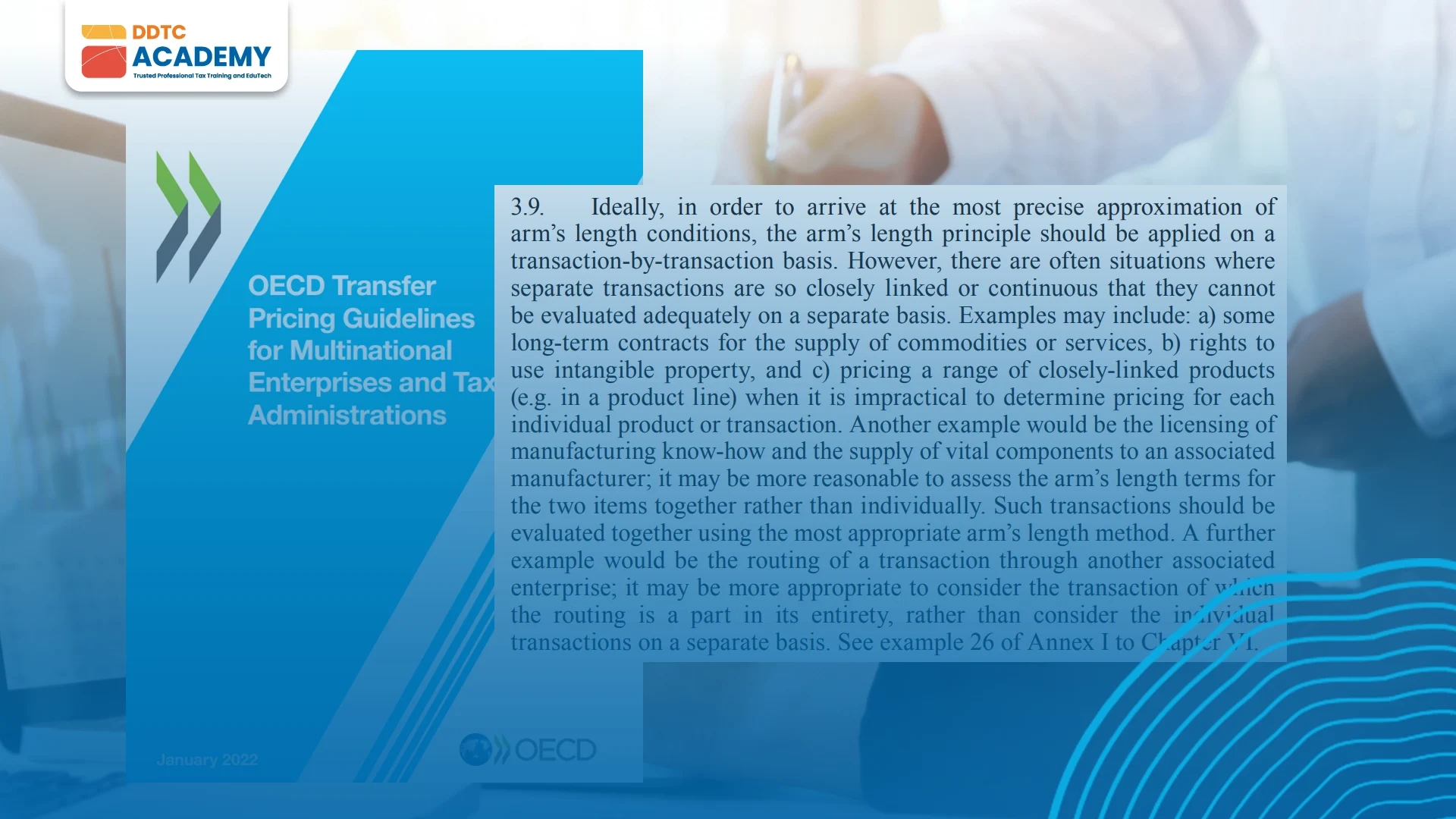
In accordance with the OECD Transfer Pricing Guidelines for Multinational Enterprises and Tax Administrations 2022 (OECD TP Guidelines), ideally, the arm's length principle should be applied on a transaction-by-transaction basis. This separate analysis of each transaction is referred to as segregation.
However, the OECD also recognizes that in practice, there are often transactions that are so closely related or occur on a continuous basis that it would be inappropriate to analyze them separately. In such cases, there is room for a combined or aggregated analysis.
The transfer pricing analysis guidelines in relation to the application of the arm's length principle are also adopted in Indonesia. Under Article 4 paragraph (2) of PMK 172/2023, the arm's length principle must be applied separately for each type of transaction influenced by a special relationship.
Furthermore, Article 4 paragraph (3) of PMK 172/2023 regulates the situation where 2 or more types of transactions influenced by a special relationship are interrelated and influence one another in determining the transfer price, such that the arm's length principle cannot be applied reliably and accurately on a separate basis.
In such cases, still in accordance with Article 4 paragraph (3) of PMK 172/2023, the arm's length principle may be applied by combining two or more types of transactions influenced by a special relationship. However, no further criteria or examples are provided regarding this provision.
The OECD provides several examples of analyses that may be conducted using the aggregation approach. Below are some examples of situations where transaction-by-transaction analysis is difficult to perform, making aggregated analysis permissible.
The segregation versus aggregation approach is one of the key issues that must be properly understood. Moreover, transfer pricing analysis in the application of the arm's length principle will also determine the quality of the transfer pricing document (TP Doc).
Both approaches are also discussed in the DDTC book titled Transfer Pricing: Ideas, Strategies, and Practical Guide in International Tax Perspective (Second Edition - Vol 1). You can access the e-book version of this book at DDTC Tax.
Interested in deepening your understanding of transfer pricing analysis as part of TP Doc? You can join the DDTC Academy practical course titled Transfer Pricing Documentation: Accurate Analysis for Tax Risk Mitigation on Saturday, 13 June 2026, 09:30–16:30 WIB at Menara DDTC.
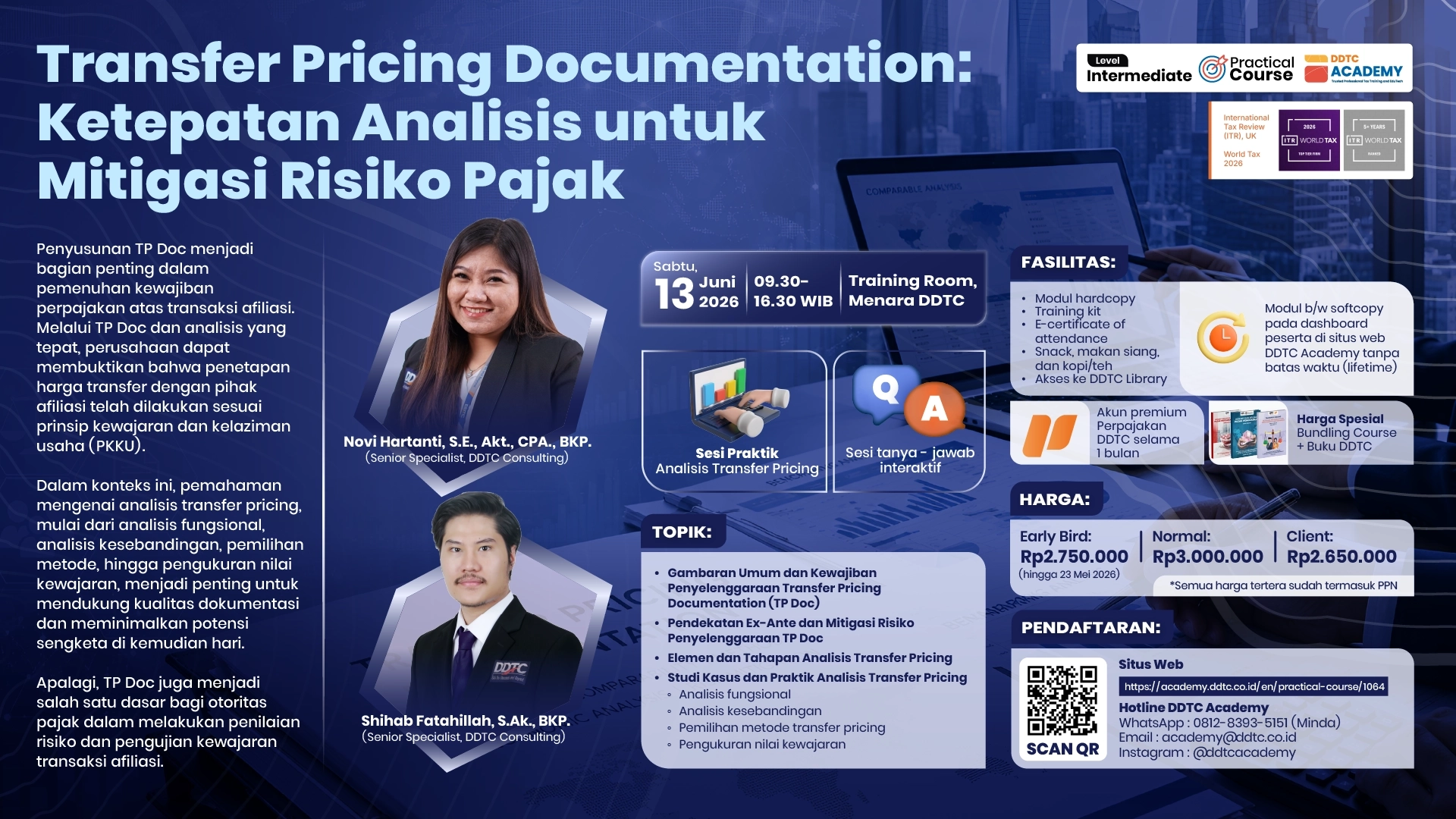
In this practical course, participants will gain a comprehensive understanding of the general framework for TP Doc, the application of the ex-ante approach, and the stages of transfer pricing analysis in preparing TP Doc.
To enrich this understanding, there will be a special session for transfer pricing analysis simulation. This simulation includes functional analysis, comparability analysis, selection of the appropriate transfer pricing method, and measurement of arm's length value.
This practical session is expected to help participants understand the application of the analysis in a more hands-on manner, including in supporting tax risk mitigation and testing compliance with the arm's length principle.
The presenters for this event are two DDTC professionals with extensive experience in transfer pricing documentation compliance. They are DDTC Consulting Senior Specialist Novi Hartanti, S.E., Akt., CPA., BKP. and Shihab Fatahillah, S.Ak., BKP.
Interested? Registration is still open. Secure your seat now by registering through the DDTC Academy website. Also, take advantage of the special bundling price for this program and DDTC books.
To get the special bundling price for the seminar and DDTC book, please contact DDTC Academy's WhatsApp Hotline at 0812-8393-5151 (Minda).
Participants will also receive the following facilities:
What are you waiting for? Register now through the DDTC Academy website. Having trouble registering? Contact DDTC Academy's WhatsApp Hotline at 0812-8393-5151 (Minda), email [email protected], or through the DDTC Academy Instagram account (@ddtcacademy).
You can also view the various programs to be held by DDTC Academy in 2026 through the booklet titled Rooted, Growing & Trusted.